.svg)


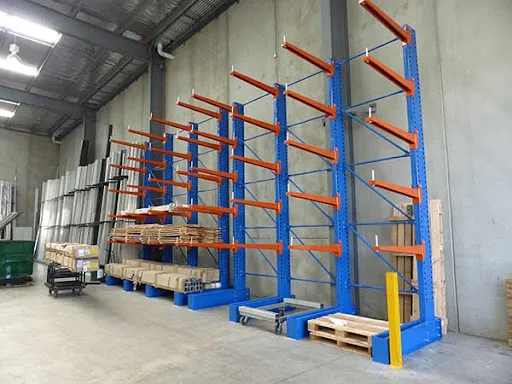
Australian Standard AS4084:2023 sets the national requirements for the design, fabrication, erection, operation, inspection and maintenance of steel storage racking in warehouses and industrial facilities. It applies across common systems, from pallet and selective racking to drive-in and cantilever. It exists to reduce collapse risk, protect people and ensure load integrity across operations. This guide explains what the standard covers, the key changes introduced in 2023, who should comply, what inspections look like (including the role of a competent person), and practical maintenance and repair advice aligned to AS4084. Warehouse managers, safety officers and racking designers will find checklists, concise summaries of updates and clear steps for building a maintenance program. The sections that follow turn technical requirements into day-to-day actions that lower incident risk and limit downtime.
What is AS4084 and why it matters for warehouse safety
AS4084 is Australia’s technical standard for steel storage racking and covers the full lifecycle: design requirements, fabrication quality, erection practices, operational controls, inspection routines and maintenance. It matters because it provides an evidence-based framework to prevent racking collapse, protect workers and safeguard stored stock, reducing both safety incidents and operational disruption. Published by Standards Australia, the 2023 revision sharpens responsibilities, updates inspection guidelines and accounts for modern risk factors such as seismic exposure and increased automation. Following AS4084 helps teams manage loads more predictably and keeps documentation in place for regulators and insurers.
What AS4084 covers in racking design and day-to-day operation
The standard specifies design parameters, including load capacity verification, member strength and stability, anchorage and bracing requirements, and details components such as uprights, beams, footplates and bracing. Designers must show how load ratings are calculated and verified, and fabricators and installers must meet consistent quality controls to avoid premature failure. On the operational side, AS4084 sets out safe work practices, load-limit signage, forklift operator training expectations and procedures for managing static and dynamic loads. Together these rules ensure uprights, beams, baseplates and bracing are specified, installed and monitored so the whole racking system performs reliably.
How AS4084 has evolved in the 2023 edition
AS4084:2023 builds on prior editions by clarifying the competent person role, updating inspection frequency guidance and recognising modern risk drivers like automation and seismic resilience. The update reflects incident data and industry feedback, tightening documentation expectations and shifting toward lifecycle management rather than one-off certification. Since AS4084-2012 the industry has seen denser storage, taller racks and more automated handling, all of which changed risk profiles. The 2023 changes aim to align technical design with operational reality and make inspection records more actionable for facility teams.
Key updates and what they mean for your operations
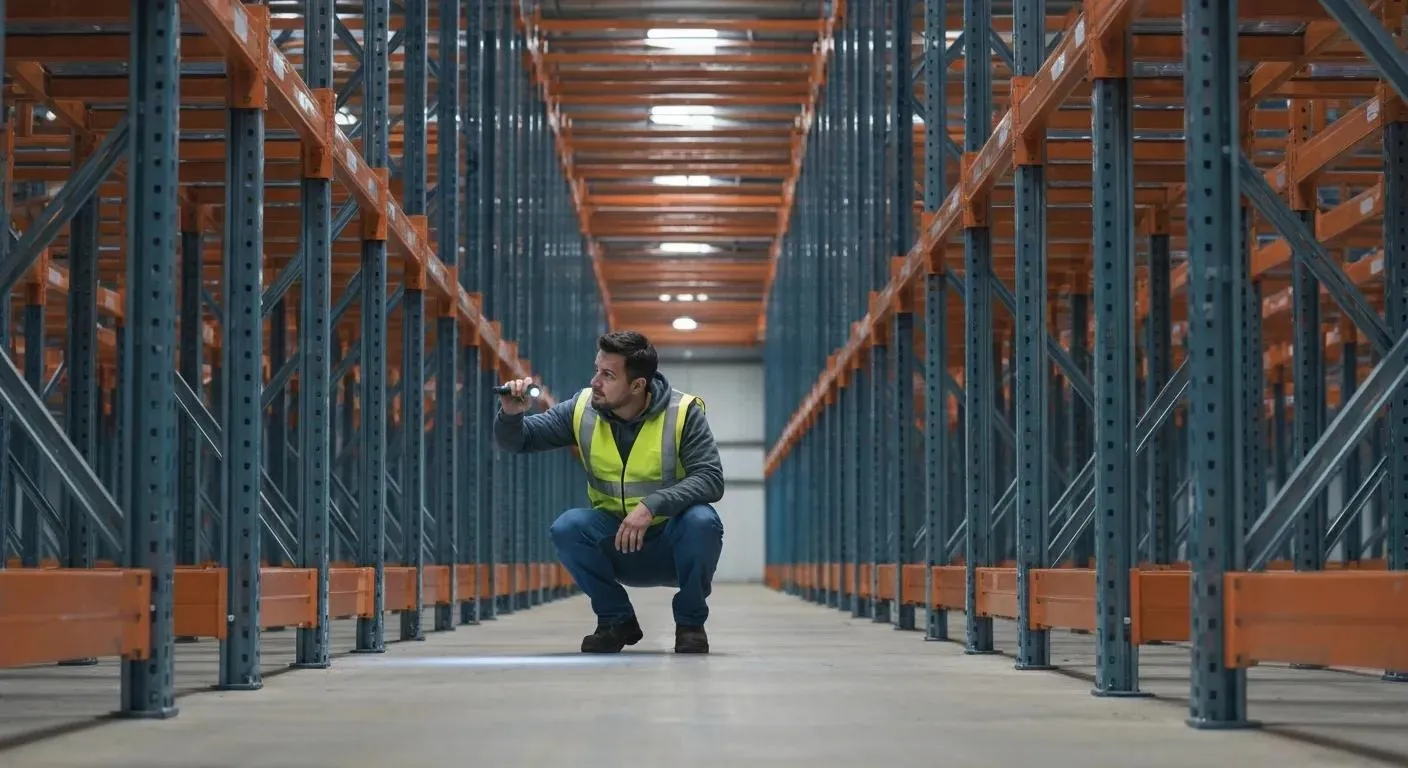
AS4084:2023 brings notable changes affecting design verification, inspection descriptors, seismic guidance and documentation expectations. The revision concentrates on a clearer definition of a competent person, explicit anchorage and bracing requirements, and stronger record-keeping for inspections and repairs. Practically, facilities should expect to update inspection forms, revise documentation practices and, where relevant, review anchorage strategies for high-bay or seismically exposed sites. Below are the main update categories with a concise summary to help translate the changes into operational actions.
Key update categories include:
- Design verification: clearer proof requirements for load ratings and connections.
- Inspection standards: defined roles and suggested periodicity for internal and competent inspections.
- Seismic guidance: more explicit anchorage and design margins for higher-risk zones.
- Operational controls: stronger expectations for documentation and maintenance scheduling.
Each category drives practical changes, ranging from revised inspection paperwork to design reviews that feed into maintenance planning.
The table below summarises the most important changes and their operational impact.
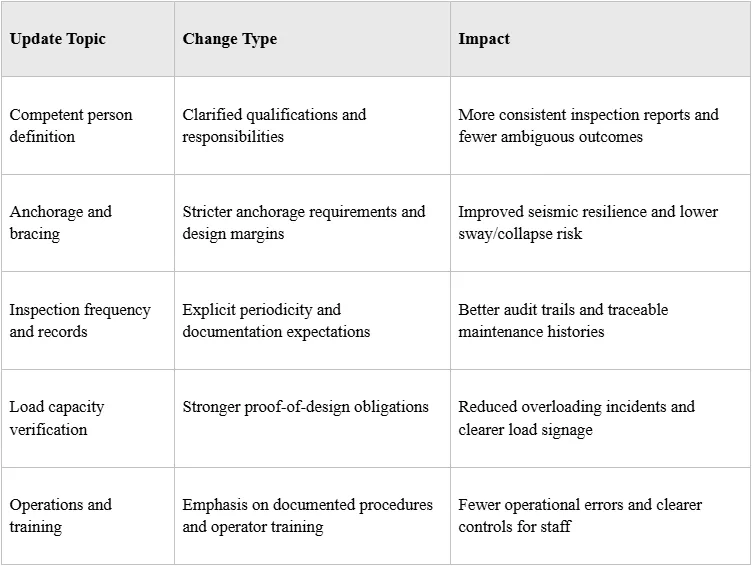
New design requirements in AS4084:2023, Part 1
Part 1 tightens design expectations by requiring demonstrable load calculations, specified anchorage and bracing strategies, and clear checks for connections and tolerances. Designers must show how racking behaves under static and dynamic loads and include margins where seismic or dynamic impacts are expected. The standard reinforces treating uprights, beams and bracing as an integrated system rather than isolated parts, and it stresses fabrication tolerances and connection integrity. For new installations, engineers should review anchor bolt specifications, baseplate detailing and bracing layouts to confirm compliance with the updated limits.
Those design requirements lead directly into how Part 2 addresses operation, maintenance and records for both new and existing installations.
How Part 2 covers operations and maintenance
Part 2 focuses on operational controls, inspection scheduling, maintenance thresholds and record-keeping. Facilities must keep clear records of periodic inspections, repairs, load signage and any structural changes, and the standard outlines expected maintenance intervals and training for staff involved in racking operations. It also highlights operational procedures, such as safe stacking and forklift approach, to prevent damage and misloading that can compromise structure. The combined effect is to encourage lifecycle management: ongoing monitoring, timely repairs and auditable records that demonstrate compliance over time.
Seismic considerations introduced in AS4084:2023
The 2023 standard provides clearer guidance for seismic assessment, asking designers and owners to account for seismic zones when specifying anchorage, bracing and connection capacities. Facilities in moderate to high seismic risk areas should plan for additional design margins, stronger anchorage systems and possibly reconfigured bracing to resist lateral forces. Seismic guidance also raises maintenance priorities: anchor checks and bracing condition should be inspected more frequently in sensitive locations. These measures reduce the risk of catastrophic racking failure in seismic events and align storage safety with broader structural resilience practices.
Implementing seismic measures typically requires collaboration between racking designers, structural engineers and operations teams. This brings us to who must comply and what compliance looks like.
Who must comply with AS4084:2023 and what compliance requires
AS4084 applies to organisations that design, install, operate or maintain steel storage racking, commonly including warehouses, distribution centres, manufacturing plants and any site using pallet or selective racking. Compliance centres on meeting Part 1 design requirements, scheduling and documenting inspections and repairs under Part 2, and keeping records that demonstrate ongoing conformity. Non-compliance increases safety risk, regulatory and legal exposure and can complicate insurance claims after incidents. The list below shows facility types that should prioritise AS4084 and the main compliance actions they should expect.
Facilities that typically must comply include:
- Warehouses and distribution centres using pallet racking systems.
- Manufacturing plants with internal storage racks for parts or finished goods.
- Third-party logistics providers and fulfilment centres handling high-density pallet storage.
These categories help teams identify where to focus compliance efforts and clarify the consequences of not meeting the standard.
Consequences of non-compliance with AS4084
Failing to comply can increase the likelihood of racking collapse, worker injury, regulatory penalties and disputed insurance claims where inspection or maintenance records are missing. Operational impacts include downtime for repairs or investigations, product loss and reputational damage that affects customers. In some cases, legal liability can follow if negligence is evident through inadequate records. Industry cases show that poor documentation has led to prolonged downtime and contested insurance payouts after failures, underscoring the value of consistent, auditable compliance.
Those risks explain why clear inspection regimes and a well-defined competent person role are central to AS4084:2023 compliance.
Inspection requirements under AS4084:2023 and the competent person role
The standard describes a tiered inspection model: daily visual checks by operators, periodic internal inspections by trained staff and annual or event-triggered inspections by a competent person with racking or structural expertise. Inspections should confirm upright and beam condition, anchor integrity, bracing performance, correct load signage and signs of damage or deformation. Each inspection must be recorded, noting findings, remedial actions and follow-up dates to support an auditable maintenance program. This layered approach balances practical day-to-day checks with technically competent verification where risks are higher.
The table below compares typical inspection actors, their qualifications and the usual scope and frequency of their duties.
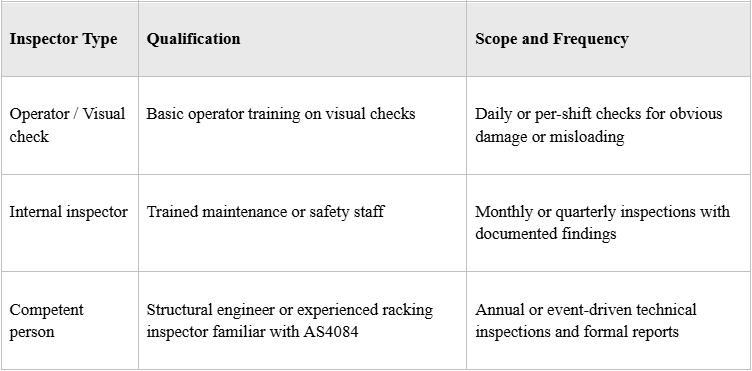
This layered model clarifies responsibilities and leads into who qualifies as a competent person.
Who qualifies as a competent person for AS4084 inspections?
A competent person under AS4084:2023 is an individual with demonstrable experience in racking design, inspection or structural engineering who understands the standard and can interpret the structural significance of damage or changes. Typical backgrounds include structural engineers, racking designers and long-experienced racking inspectors able to assess connection integrity, deformation tolerances and recommend remediation in line with the standard. The competent person should provide a written inspection report that identifies non-conforming elements, assigns risk ratings and prescribes repair or replacement actions. Choosing an inspector with domain expertise reduces ambiguity in technical decisions and strengthens the defensibility of maintenance records.
What an annual AS4084 inspection checklist should include
An annual checklist should cover upright and beam deformation, beam-to-upright connection integrity, missing or damaged safety components (for example row spacers and locking pins), anchor bolt condition, bracing and end-frame stability, correct load signage and records of prior repairs. It should include photographic evidence, measured deformation where relevant, a severity rating for each defect and a recommended corrective timeline aligned to AS4084 thresholds. The checklist must capture immediate safety risks and items needing scheduled remediation, and it should be stored in a searchable maintenance log. A strong checklist turns inspection findings into prioritised repairs and continuous improvement.
Which racking systems does AS4084 apply to?
AS4084 broadly covers steel storage racking used in warehouses, including pallet racking, selective racking, drive-in/drive-through systems and cantilever racking, although application details vary by system. The standard’s core principles for design, anchorage, inspection and maintenance apply across these types, but specialised systems (for example bespoke automated storage and retrieval systems) may need additional engineering guidance to address unique loads or dynamics. AS4084 focuses on common racking components while allowing engineers to reference supplementary standards when specific technologies introduce atypical load cases. Knowing your system type is essential to apply the right inspection points and maintenance schedule.
Applying AS4084:2023 to pallet and selective racking
For pallet and selective racking, the standard emphasises verifying load ratings, beam alignment, row and bay stability, anchorage adequacy and clear load signage for each storage location. Inspections should focus on beam end damage, upright bowing, connector integrity and baseplate anchorage, as these components directly affect load distribution and stability. Operational controls, such as pallet placement protocols and forklift approach procedures, are also important because improper handling is a common cause of localised damage. Applying AS4084 means combining technical design checks with routine operational practices to maintain system integrity.
Drive-in, drive-through and cantilever systems: how AS4084 applies
AS4084 covers drive-in, drive-through and cantilever systems in principle, but these formats often need extra engineering attention due to different load paths, repeated vehicle impacts or asymmetrical loading. Drive-in systems, for example, concentrate loads and are more exposed to dynamic impacts from forklifts, requiring focused inspection of runners and guides. Cantilever racking introduces different bending moments and connection details that must meet Part 1 design limits. When systems depart from conventional pallet/selective designs, consult an engineer to interpret AS4084 against those unique load cases.
Maintaining AS4084 compliance through repairs and prevention
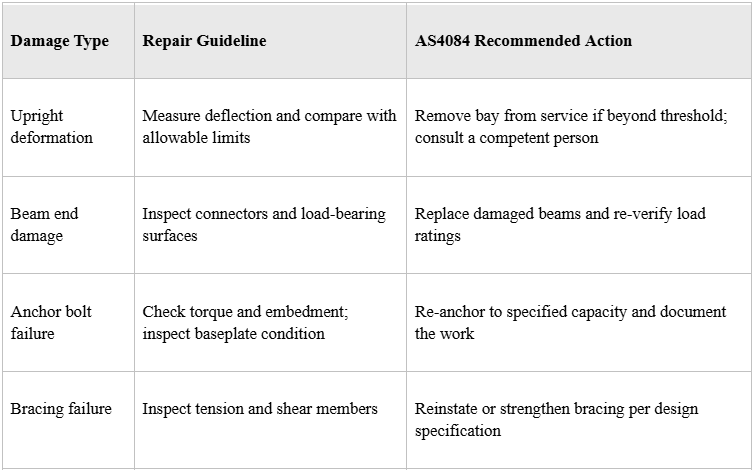
Staying compliant requires a structured program that combines immediate repair thresholds, documented repair actions that follow AS4084 guidance, preventative controls to reduce damage, and a continuous improvement loop captured in maintenance records. An effective program includes criteria to take damaged bays out of service, clear repair versus replace thresholds, routine anchor checks, operator training to reduce impacts, and scheduled competent person inspections. Preventative measures, such as guard rails, clear signage and targeted forklift coaching, lower the frequency and severity of damage. The table below maps common damage types to repair guidance and AS4084 recommended actions for quick reference.
Intro to damage to action mapping:
Common racking damage and AS4084 repair guidance
Typical damage includes upright bowing, beam end distortion, connection failures, missing locking devices, corrosion and loosened anchor bolts. AS4084 provides thresholds that determine whether repair, reinforcement or replacement is required. Immediate steps are to secure the affected bay, commission a technical assessment by a competent person, document the damage and schedule corrective work according to severity. If deformation exceeds allowable limits, the standard advises removing the bay from service and replacing or repairing members rather than applying temporary field fixes that do not restore certified capacity. Prompt, documented repair prevents escalation and shows adherence to the standard.
With these responses in hand, you can design a maintenance program that keeps racking safe and compliant.
Building an effective racking maintenance program aligned to AS4084
An AS4084 aligned program should include scheduled inspections (daily operator checks, regular internal inspections and annual competent person reviews), fast repair workflows, training for material handling staff and centralised record keeping for inspections and repairs. Assign responsibilities, define frequencies and set acceptable response times for different severity levels. Use inspection data to drive preventative measures, for example, adding guards or changing procedures, and hold regular review sessions to prioritise capital repairs as operations change. These steps keep the program effective as your facility evolves.
Use this practical checklist as a starting point for implementation.
- Set up daily operator visual checks with photographic logging for obvious damage.
- Schedule monthly internal inspections and record findings with corrective actions.
- Arrange annual competent person inspections with formal reports and risk ratings.
- Keep a centralised repair log that records actions, dates and verification steps.
- Deliver targeted training for forklift operators and update procedures after incidents.
If you need help interpreting AS4084:2023, Skyteck Online can provide expert perspective and practical advice for integrating inspection and maintenance practices into your workflows. Skyteck Online focuses on education, correct application of competent inspections and building documentation systems that align with the standard, helping teams prioritise next steps and tailor a program to their racking systems and operational risk profile.